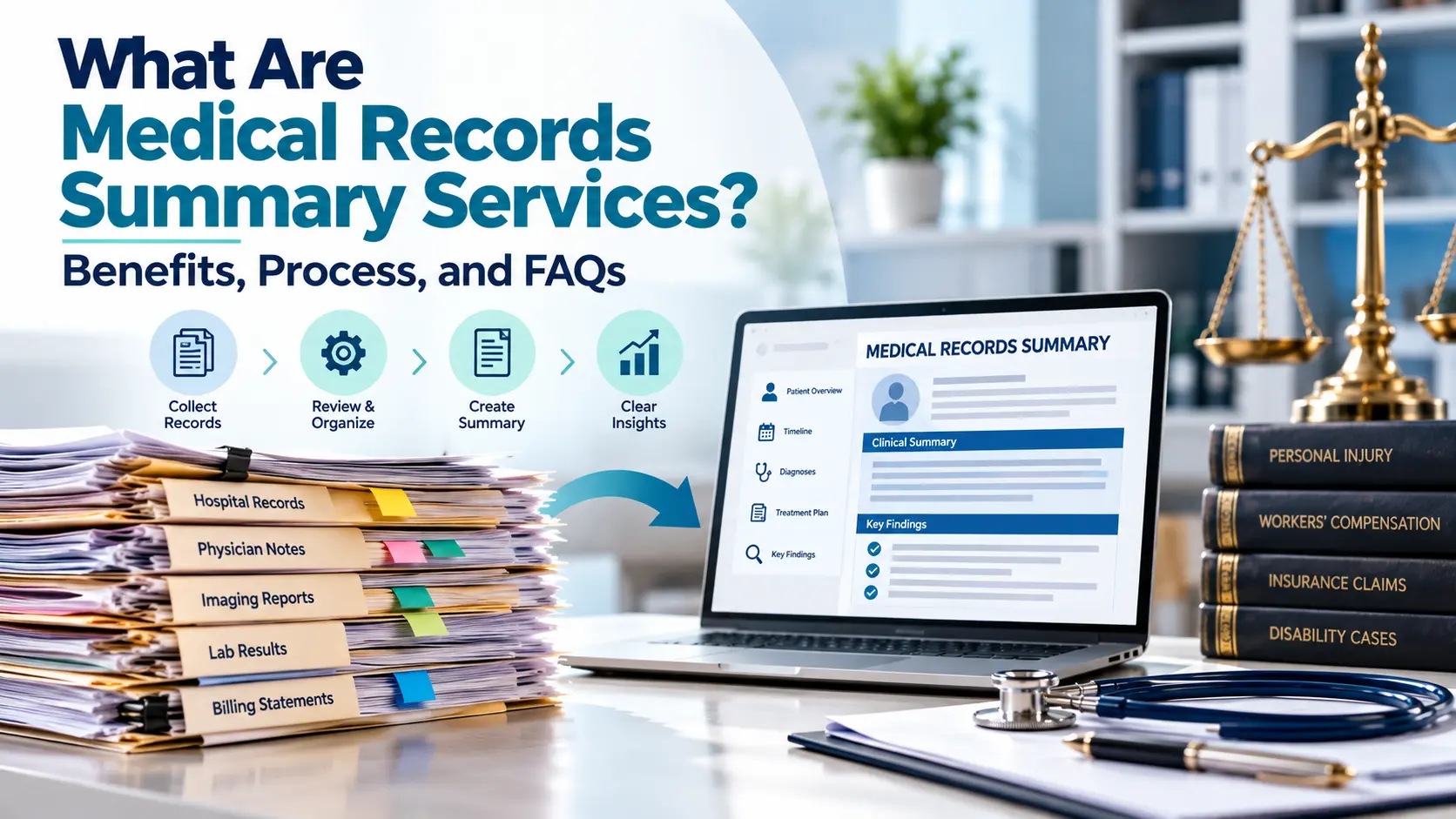
What Are Medical Records Summary Services? Benefits, Process, and FAQs
A practical breakdown of what medical records summary services actually do, how the process works, and when it makes sense to bring in outside help.
Case files built on medical evidence rarely arrive clean. They land in stacks of hospital records, provider notes, imaging reports, and billing statements, often hundreds of pages deep and out of order. Medical records summary services exist to turn that raw stack into a structured, chronological narrative that's actually usable for case strategy, claims decisions, or trial prep.
1. What Are Medical Records Summary Services?
At their core, these services take unorganized clinical documentation and convert it into a clear, chronological account of a patient's treatment history. Rather than reading through every page of every provider's file, an attorney, adjuster, or examiner works from a condensed summary that highlights diagnoses, treatment dates, providers involved, and any findings relevant to the case at hand.
This isn't simple data entry. A properly built summary requires someone who can read clinical terminology accurately, spot inconsistencies across providers, and organize findings in a way that supports — rather than obscures — the underlying case narrative.
2. Who Relies on These Services
- Personal injury attorneys — establishing injury, treatment, and causation
- Workers' compensation attorneys — tracking treatment against claimed injury
- Disability and long-term care attorneys — supporting eligibility determinations
- Insurance claims adjusters — evaluating claims against medical evidence
- Case management teams — coordinating ongoing treatment across providers
3. Benefits of Outsourced Record Summarization
- Faster case review — hundreds of pages condensed into a usable narrative
- Consistent formatting — every summary follows the same structure, regardless of who reviewed it
- Fewer overlooked details — trained reviewers are less likely to miss a gap or inconsistency
- Freed-up staff time — associates and paralegals focus on strategy instead of manual review
- Scalable capacity — record volume can spike without adding headcount
4. The Summarization Process, Step by Step
Intake and organization. Records are collected from every provider, converted to a searchable format, and sorted by source.
Chronological sequencing. Every entry is placed on a single timeline spanning pre-injury baseline through current status.
Clinical review. A trained reviewer reads each record, extracting diagnoses, treatment, and provider notes relevant to the case.
Flagging and cross-referencing. Gaps in treatment, pre-existing conditions, and billing mismatches are noted for attorney review.
Summary drafting. Findings are organized into a standardized summary format with page citations back to the source record.
Quality review and delivery. The summary is checked for accuracy before delivery, typically alongside a bookmarked, searchable copy of the full record set.
5. What's Typically Included in a Summary
| Section | What It Captures |
| Provider & Visit Log | Every provider seen, visit dates, and visit type |
| Diagnoses & Findings | Formal diagnoses and key clinical findings by date |
| Treatment & Medications | Treatment plans, procedures, and prescriptions over time |
| Imaging & Diagnostic Reports | Radiology and diagnostic findings, compared across studies |
| Billing Cross-Reference | Itemized charges checked against the treatment record |
| Flagged Issues | Gaps, inconsistencies, and pre-existing conditions worth review |
6. Signs Your Team Needs to Outsource
- Paralegals spend more time summarizing records than on case strategy
- Discovery or mediation deadlines are being pushed by review backlog
- Case volume has outgrown internal review capacity
- Summaries vary in quality between team members
- Files needing turnaround measured in days, not weeks, keep piling up
7. Choosing the Right Partner
Not every summarization vendor is built for legal or claims work. Before engaging a partner, confirm they can meet these baseline standards:
| ✓ Experience with legal-specific chronology formats | ✓ HIPAA-compliant handling and secure file transfer |
| ✓ Reviewers trained to read medical terminology accurately | ✓ Consistent turnaround times for high-volume caseloads |
| ✓ Ability to flag causation and credibility issues, not just summarize | ✓ Transparent, scalable pricing tied to record volume |
Need Accurate Medical Record Summaries for Your Caseload?
Summit Global Services pairs legal-trained reviewers with structured chronology templates to deliver fast, defensible medical record summaries for personal injury, malpractice, and workers' compensation cases.
Explore Medical Records Services8. Frequently Asked Questions
It's the process of reading, organizing, and analyzing a client's medical records to build a defensible narrative of injury, treatment, and causation for a case or claim.
Personal injury, workers' compensation, medical malpractice, and disability claims all depend on structured medical record review to establish the strength of a case.
Turnaround depends on record volume and complexity, but most providers deliver standard summaries within a few business days, with rush options for tighter deadlines.
Reputable providers process files under HIPAA-compliant procedures, including secure transfer, restricted access, and signed confidentiality agreements.
Yes. A well-built summary flags treatment gaps, pre-existing conditions, and inconsistencies across providers that are directly relevant to causation and credibility arguments.