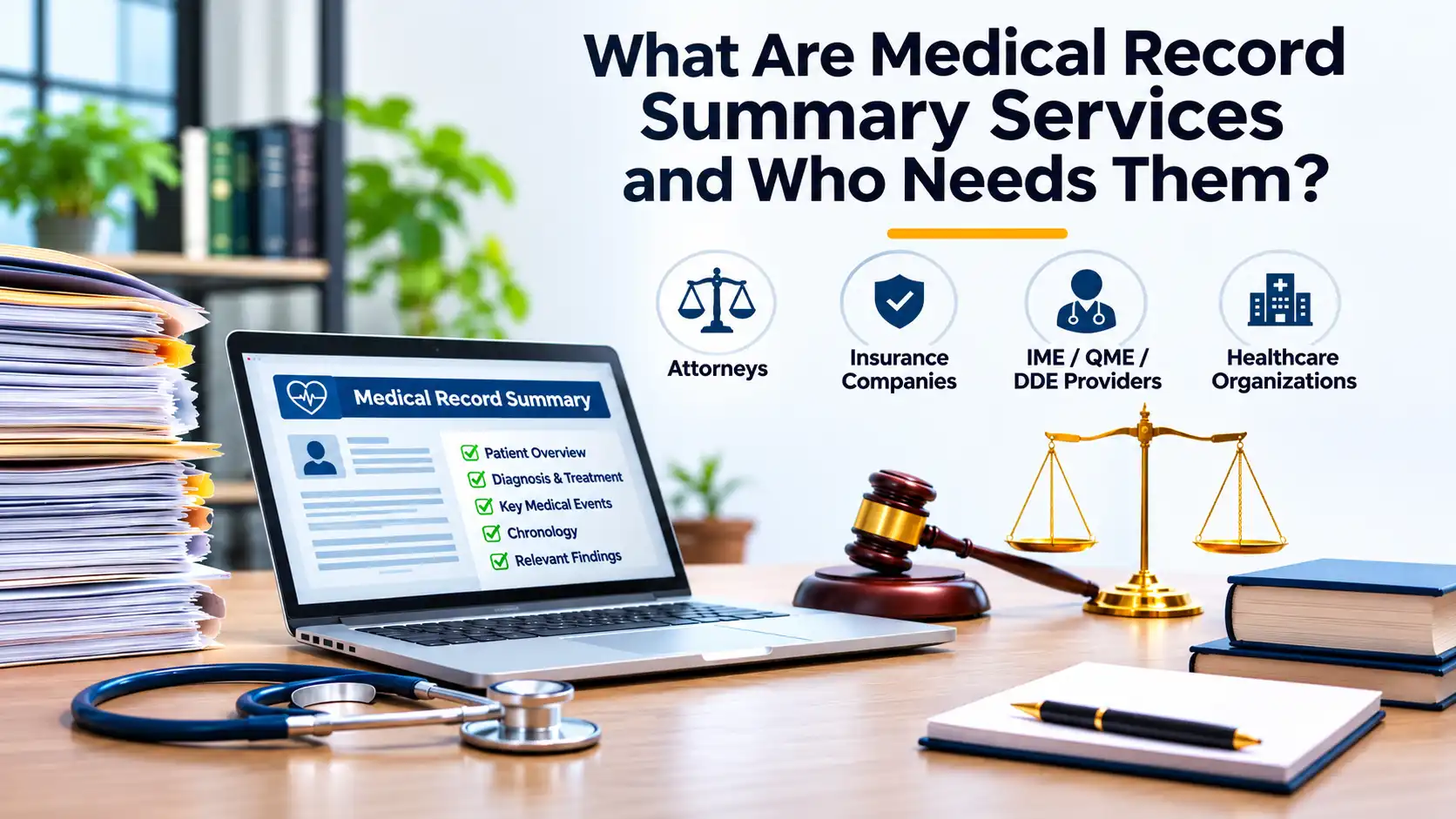
A single claim can arrive with thousands of pages of medical records: office notes, imaging reports, lab results, therapy logs, and billing entries from many providers. The facts that matter are in there, but finding them takes hours that most professionals do not have.
That is where medical records services come in. This article explains what medical record summary services are, what they deliver, and who benefits most from using them.
Why Medical Records Are Hard to Review
Medical records are written to support patient care, not to be read by an evaluator, attorney, or adjuster. That shapes how they look when they arrive.
- Many sources: hospitals, clinics, specialists, pharmacies, and imaging centres each keep their own chart.
- Mixed formats: handwritten notes, faxes, scans, and typed reports sit side by side.
- Duplicates and noise: the same report may appear several times, buried among routine paperwork.
- No clear timeline: pages are often out of date order, so treatment progress is hard to follow.
What Medical Record Summary Services Are
Medical record summary services convert raw medical records into organised, objective summaries. Trained reviewers sort the pages, build a timeline of care, and write concise summaries that link back to the original source pages.
The result is a file a physician, attorney, or claims professional can start using straight away, without reading every page first. Summit Global Services combines AI-assisted tools with review by trained medical summary professionals, so speed does not come at the cost of accuracy.
What a Summary Typically Includes
The exact package depends on the case, but most projects draw from the same set of deliverables.
| Deliverable | What it contains | Why it helps |
|---|---|---|
| Bookmarked, searchable records | Records sorted, indexed, and made text-searchable | Any page can be found in seconds |
| Medical chronology | Visits, tests, and treatments in date order | Shows how care progressed over time |
| Treatment summary | Diagnoses, interventions, and provider opinions | Gives a clear clinical picture |
| Diagnostic test summary | Imaging, labs, and test results in one place | Avoids hunting through scattered reports |
| Gap in treatment report | Periods with no documented care | Highlights questions that may need an answer |
| Medication history | Prescriptions and changes over time | Supports review of treatment and risk |
Who Needs Medical Record Summary Services
Anyone who must make a decision from a large medical file can benefit. The need is strongest in these groups.
| Who | What they need to do | How a summary helps |
|---|---|---|
| IME and QME evaluators | Prepare exams and write opinions on causation and impairment | Treatment progress and red flags are ready before the exam |
| DDE doctors | Answer questions on MMI, impairment rating, and return to work | Records are organised around the questions being asked |
| Plaintiff and defence attorneys | Evaluate causation, damages, and case strength | A dated chronology with source links supports arguments |
| Insurance adjusters | Assess claims and reserves | Prior conditions and treatment gaps are easier to see |
| Peer reviewers | Review care against standards | Relevant entries are found without reading every page |
How the Process Works, Step by Step
- Secure uploadRecords are sent through a HIPAA-compliant, encrypted portal.
- Intake and identificationReviewers mark record boundaries and types, extract dates, providers, and facilities, and flag duplicates.
- Quality checkA person verifies the sorting, record types, and duplicates before moving on.
- Preliminary filesYou receive a list of records and a bookmarked, text-searchable PDF.
- SummarisationTreatment dates, diagnostic findings, interventions, and doctor opinions are brought together.
- Second quality checkEach summary is checked against the original pages to keep it accurate.
- Final deliveryYou receive the summary, chronology, gap report, and medication history.
How Summaries Help Your Work
- Less reading time: professionals begin with the key facts instead of page one.
- Fewer surprises: prior conditions and unknown providers are found early.
- Clearer timelines: a dated chronology makes events easy to explain.
- Source-linked points: every statement can be traced to the original page.
- More consistent work: a standard format makes each file easy to compare.
A Practical Example
Consider a hypothetical workers’ compensation claim. An evaluator receives 900 pages from five providers. The summary shows a six-week gap in treatment and a prior back complaint mentioned in a single intake form. Because both points are linked to their source pages, the evaluator can address them in the exam rather than finding them late.
This example is illustrative and not based on a specific case.
What to Look for in a Provider
- Clinical knowledge: reviewers should understand medical terms and treatment patterns.
- Human quality checks: software alone misses handwriting, faxes, and abbreviations.
- Source-page links: every entry should lead back to the original record.
- HIPAA safeguards: look for encryption and a signed business associate agreement (BAA).
- Fit for your use: output should suit IME, QME, DDE, or legal workflows.
- Clear turnaround: standard and urgent timelines should be agreed up front.
Conclusion
Medical record summary services turn large, scattered files into clear, usable summaries. For evaluators, attorneys, and claims teams, that means less time on page turning and more time on analysis and decisions.
To see how a project moves from intake to a finished summary, explore our medical records services.
Need help with complex medical records?
Share a sample file and your deadline. Our team will outline the scope, turnaround, and approach so you can move forward with confidence.
Explore Medical Records ServicesFrequently Asked Questions
What are medical record summary services?
They organise large medical files into clear, objective chronologies and summaries, with links back to the original pages.
Who uses medical record summary services?
IME, QME, and DDE evaluators, plaintiff and defence attorneys, insurance adjusters, and peer reviewers all use them.
What is included in a medical record summary?
Most include a chronology, treatment summary, diagnostic test summary, medication history, and a gap in treatment report.
Can a summary show gaps in treatment?
Yes. A dated chronology makes periods with no documented care easy to spot and review.
Why use trained reviewers instead of software alone?
Software can struggle with handwriting, faxes, and abbreviations. Trained reviewers add clinical context and check accuracy.
Are source-page references included?
Yes. Each entry links back to the original page so you can verify it quickly.
Is patient data kept secure?
Data is protected in storage and in transit using industry-standard security, and formal BAAs are available.
How long does a summary take?
Standard turnaround is 3 to 5 business days for files under 500 pages, with expedited delivery in 24 to 48 hours.
How can I get started with Summit Global Services?
Upload a test case or schedule a call through our website, and the team will outline the next steps.