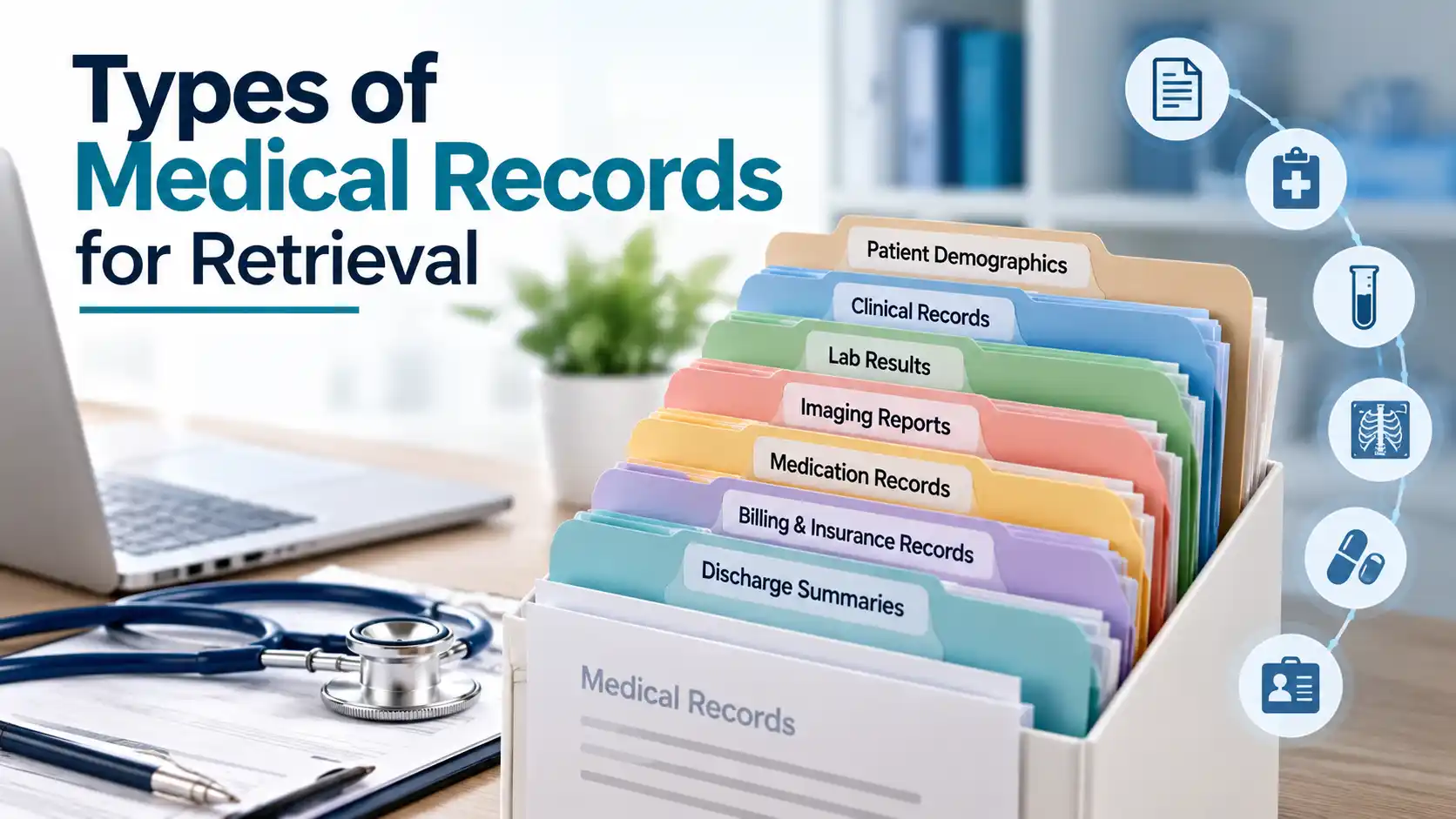
1. What Are Medical Records and Why Are They Retrieved?
Medical records are the documentation created by healthcare providers and facilities each time a patient receives care. They may include clinical notes, test results, treatment plans, medication histories, and administrative documentation tied to a course of care. Together, these documents form a timeline of a patient's diagnoses, treatments, and interactions with the healthcare system.
Organizations retrieve medical records for a range of purposes, including:
- Legal cases, such as personal injury or medical-legal matters
- Insurance claims and underwriting reviews
- Disability claims and benefit determinations
- Independent medical reviews
- Litigation support and case preparation
- General healthcare administration, such as care coordination
Requesters commonly include attorneys and law firms, insurance carriers, claims professionals, disability evaluators, healthcare organizations, and medical-legal support teams. Because each of these use cases has a different purpose, the records that are relevant to one request may not be relevant to another. A workers' compensation claim, for example, may focus on treatment tied to a specific injury and date range, while a broader legal case may require a more complete medical history. In every case, the exact records required depend on the purpose of the request, which is why understanding the available record types is a useful starting point.
2. Hospital and Inpatient Medical Records
Hospital and inpatient records document care provided during a hospital stay, from admission through discharge. These records are often detailed, since they can involve multiple departments, providers, and shifts of clinical staff over the course of treatment.
Common components of hospital and inpatient records include:
- Admission records
- Discharge summaries
- Physician notes
- Nursing notes
- Treatment records
- Medication administration records
- Operative reports
- Progress notes
- Emergency department records
- Consultation notes
- Care plans
These records may be relevant when a case involves understanding the full scope of a hospitalization, including how a condition was diagnosed, what treatment was provided, and how the patient progressed during their stay.
| Record Type | What It May Contain | Why It May Be Retrieved |
|---|---|---|
| Admission records | Reason for admission, initial assessment | Establishes the starting point of care |
| Discharge summary | Course of treatment, condition at discharge | Summarizes the overall hospital stay |
| Operative report | Procedure details, findings, outcome | Documents surgical or procedural care |
| Nursing notes | Ongoing observations, vitals, care given | Provides a day-to-day record of care |
3. Physician and Outpatient Records
Physician and outpatient records are maintained by primary care physicians, specialists, clinics, and outpatient facilities. Unlike hospital records, which cover a single admission, outpatient records often span a longer period and reflect ongoing care over time.
These records may include:
- Office visit notes
- Clinical assessments
- Diagnoses
- Treatment plans
- Follow-up notes
- Referral records
- Physician correspondence
- Progress notes
Outpatient records can provide important context both before and after a hospitalization or specific treatment event. For example, primary care notes from before an injury may help establish a patient's baseline health, while follow-up visit notes can document recovery and ongoing symptoms. This makes physician and outpatient records a frequent component of medical records for legal cases and insurance reviews alike.
4. Diagnostic and Laboratory Records
Diagnostic and laboratory records capture the results of testing performed to help diagnose or monitor a condition. These records tend to be more objective and structured than narrative clinical notes, which can make them useful for building a factual timeline.
Common diagnostic records include:
- Blood tests
- Urinalysis
- Pathology reports
- Microbiology reports
- Other diagnostic testing
- Laboratory results and interpretations
Diagnostic records can help provide objective information about what testing was performed and what the results showed. That said, these records are generally most useful when reviewed in context alongside other documentation, and any medical interpretation should be handled by appropriately qualified professionals.
5. Imaging and Radiology Records
Imaging and radiology records document diagnostic imaging performed to evaluate an injury or condition. Common types of imaging include X-rays, CT scans, MRIs, ultrasounds, and mammography, along with other forms of diagnostic imaging used in specific circumstances.
It is worth noting the distinction between two related but separate items:
- Imaging files — the actual scan images produced during the procedure
- Radiology reports — the written interpretation of the imaging, prepared by a radiologist
Depending on the purpose of the retrieval request, one or both of these may be relevant. A radiology report may be sufficient for understanding findings and conclusions, while the imaging files themselves may be needed for further review or a second opinion. Because imaging files can be large and are sometimes stored separately from the rest of a medical record, maintaining these records in an organized and accessible format is important for a smooth retrieval process.
6. Pharmacy, Medication and Prescription Records
Pharmacy and medication records document the prescriptions a patient has been given and how those medications were administered or filled over time. These records can include:
- Prescription records
- Medication lists
- Pharmacy records
- Medication administration records
- Refill information
- Medication history
Pharmacy and medication records may help establish a medication history and build a timeline of treatment, which can be useful for understanding how a condition was managed over time. As with other record types, these documents are informational in nature, and this article does not offer medical recommendations or interpretations of any individual's treatment.
7. Rehabilitation and Therapy Records
Rehabilitation and therapy records document care provided by physical therapists, occupational therapists, speech therapists, rehabilitation facilities, and other post-surgical or post-injury treatment providers. These records often reflect a patient's functional status and recovery over an extended period.
Rehabilitation records may include:
- Treatment dates
- Therapy notes
- Functional assessments
- Progress documentation
- Treatment plans
- Recommendations
- Discharge information
Because rehabilitation is often an ongoing process, these records can provide a useful picture of how a patient's condition changed over the course of treatment, including improvements, setbacks, and the eventual outcome of a course of therapy.
8. Billing, Insurance and Other Supporting Records
In addition to clinical documentation, several categories of supporting records often accompany a medical record request. The specific documents needed depend on the purpose of the request.
Medical Billing Records
Typically include itemized charges, procedure and diagnosis codes, and dates of service, which can help confirm when and where treatment occurred.
Insurance Records
May include claims-related documentation submitted by a provider or facility, which can help track how a claim was processed.
Explanation of Benefits (EOB)
Generally summarizes how an insurance claim was processed, including what was billed, what was covered, and what portion, if any, was the patient's responsibility.
Authorization Records
Documentation such as signed release forms, which may be relevant since providers typically require proper authorization before releasing medical records.
Referral Records
Help connect different providers and treatment episodes, showing how a patient moved from one type of care to another.
Other Supporting Documentation
Relevant correspondence or administrative records that may be part of a complete retrieval, such as provider communications tied to a treatment episode.
9. Choosing the Right Medical Records for Retrieval
With so many possible record types, determining which ones are actually needed for a specific case can be one of the more time-consuming parts of the process. The following steps offer a general framework for approaching this decision.
- Define the purposeLegal, insurance, disability, or administrative need
- Identify providersHospitals, physicians, specialists, therapists involved
- Determine the date rangeRelevant treatment period for the request
- Identify treatment typesInpatient, outpatient, therapy, or specialty care
- Consider diagnostic recordsLab work, testing, or imaging tied to the case
- Consider billing documentationOnly where relevant to the request
- Identify missing recordsGaps between known treatment events
- Track outstanding requestsWhich providers have and have not responded
- Review for completenessConfirm records match the requested date range
- Organize documentationSort chronologically or by provider for review
Because record requests can involve multiple providers, formats, and follow-ups, many organizations rely on professional medical record retrieval services to help manage the process from initial request through final organization of the documentation. This can be particularly useful for cases involving a high volume of records or providers spread across different systems.
Need Help Retrieving Medical Records?
Gathering the right combination of hospital, physician, diagnostic, imaging, pharmacy, and rehabilitation records can involve significant coordination, especially across multiple providers. Summit Global Services offers medical records services designed to help attorneys, insurers, and healthcare organizations manage requests, follow-ups, and document organization as part of a more structured retrieval process.
Explore Medical Records Services10. Frequently Asked Questions
What are the main types of medical records?
The main types include hospital and inpatient records, physician and outpatient records, diagnostic and laboratory records, imaging and radiology records, pharmacy and medication records, rehabilitation and therapy records, and billing or insurance-related documentation. The records needed depend on the purpose of the request.
Why are medical records retrieved?
Medical records are commonly retrieved to support legal cases, insurance claims, disability determinations, medical reviews, litigation support, and healthcare administration.
What hospital records can be requested?
Hospital records may include admission records, discharge summaries, physician and nursing notes, operative reports, medication administration records, progress notes, and emergency department records.
What are physician and outpatient records?
These are records maintained by primary care physicians, specialists, and clinics, including office visit notes, diagnoses, treatment plans, and referral documentation.
What diagnostic records may be included in a medical record request?
Diagnostic records may include blood tests, urinalysis, pathology and microbiology reports, and other laboratory testing results relevant to the case.
Are imaging files part of medical record retrieval?
Yes. Imaging records may include both the imaging files themselves, such as X-rays or MRIs, and the radiology reports that interpret them, depending on what the request requires.
Can pharmacy and prescription records be retrieved?
Yes. Pharmacy and prescription records, including medication lists and refill history, can typically be retrieved to help document medication history over time.
What rehabilitation records may be requested?
Rehabilitation records may include physical, occupational, or speech therapy notes, functional assessments, treatment plans, and discharge documentation.
How do I know which medical records I need to retrieve?
Start by defining the purpose of the request, then identify the relevant providers, date range, and treatment types involved, considering diagnostic and billing records where applicable.
Can professional medical record retrieval services help with large requests?
Professional medical record retrieval services can help manage the process of requesting, tracking, and organizing records, which can be especially useful for cases involving multiple providers or high volumes of documentation.