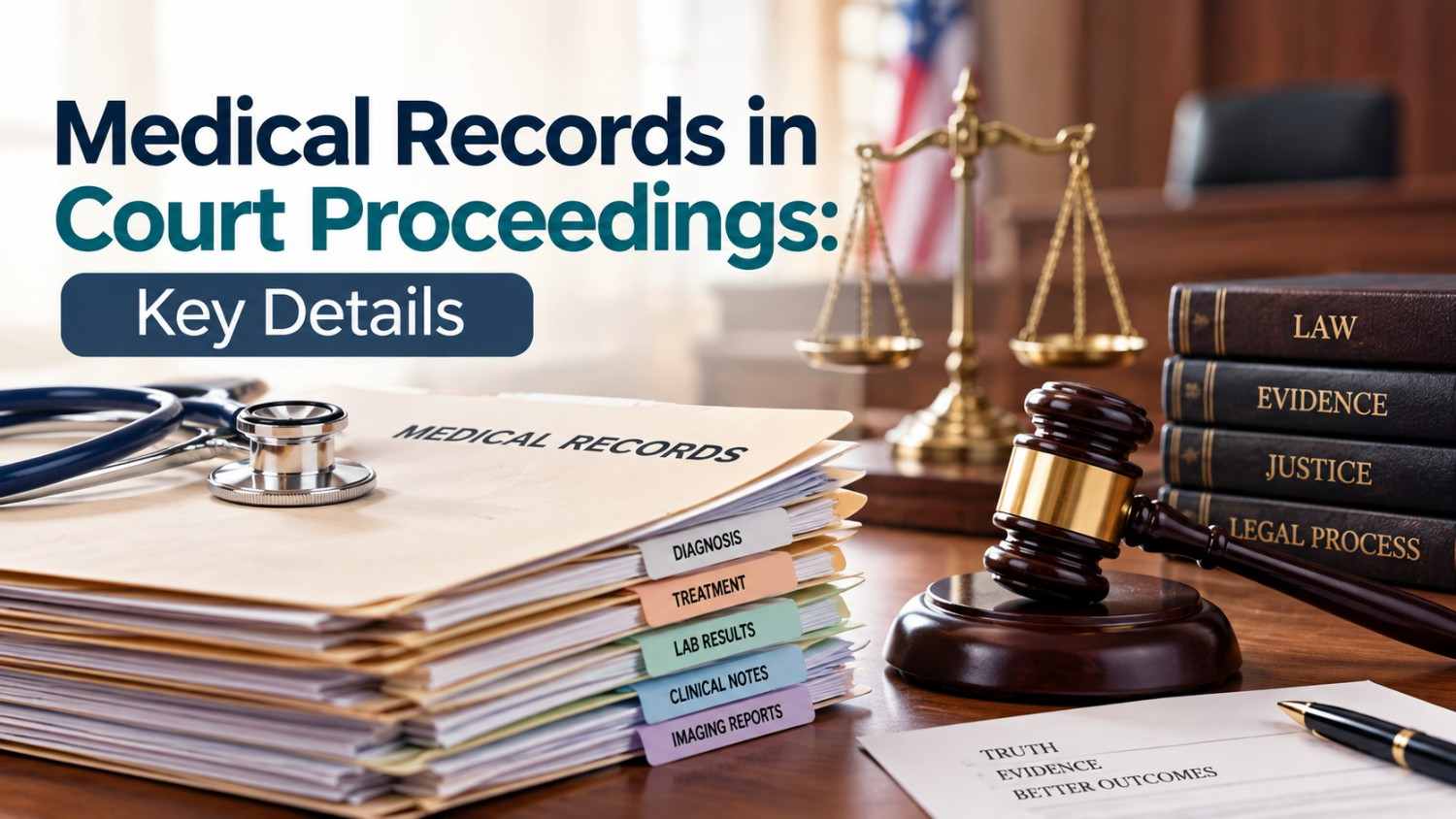
1. What Are Medical Records in Court Proceedings?
Medical records are documents created by healthcare providers that describe a patient's care, diagnosis, and treatment over time. In a legal setting, these documents may become relevant whenever a person's health, injuries, or medical history are at issue in a case. This can include personal injury claims, medical malpractice matters, workers' compensation cases, insurance disputes, disability claims, and other proceedings where medical facts are part of the record.
Common examples of documentation that may be part of a medical record include:
- Physician notes from office visits
- Hospital admission and discharge records
- Diagnostic reports
- Laboratory results
- Imaging reports, such as X-rays, MRIs, or CT scans
- Treatment and progress notes
- Medication and prescription records
- Rehabilitation and physical therapy records
- Specialist consultation records
- Billing-related medical documentation
Taken together, these documents can provide a chronological picture of a person's treatment and medical history, from an initial visit through ongoing or follow-up care. It's worth noting, however, that not every medical record that exists is automatically admissible as evidence in a proceeding. Whether a specific record can be used, and how, depends on the applicable rules of evidence, the jurisdiction, and the facts of the case — which is a legal question outside the scope of this article.
2. Why Medical Records Matter in Legal Cases
When a case involves an injury or medical condition, records can help legal professionals build a factual understanding of what occurred. Reviewing this documentation may help clarify:
- The nature and extent of an injury or condition
- Treatment history and the sequence of care
- Specific dates of treatment
- Medical expenses associated with care
- Progress or changes in a patient's condition over time
- Prior medical history relevant to the current claim
- Follow-up care and rehabilitation
- Physician observations recorded during treatment
One of the most practical uses of medical records in a legal matter is helping establish a timeline — connecting an incident to the treatment that followed it, and documenting how a condition evolved. This kind of supporting documentation can be useful during case preparation, negotiation, or trial, depending on the matter.
3. Types of Medical Records Used in Court
Medical documentation used in legal matters generally falls into several broad categories. The table below outlines common types and the kind of information each may contain.
| Record Type | What It May Include |
|---|---|
| Hospital Records | Admission and discharge summaries, emergency department notes, inpatient treatment documentation |
| Physician Records | Office visit notes, clinical assessments, treatment plans, follow-up instructions |
| Diagnostic Records | Imaging reports (X-ray, MRI, CT), laboratory testing, and other diagnostic findings |
| Prescription and Medication Records | Medications prescribed, dosages, and treatment duration |
| Rehabilitation and Therapy Records | Physical therapy, occupational therapy, and related progress documentation |
| Billing and Medical Expense Records | Itemized costs, treatment codes, and related financial documentation |
| Specialist Records | Consultation notes and findings from specialists involved in a patient's care |
Hospital Records
Hospital records often serve as a starting point in cases involving an acute injury or emergency treatment, since they typically document the initial presentation and immediate course of care.
Physician Records
Office notes and assessments from treating physicians can add detail about ongoing symptoms, diagnoses, and the reasoning behind a treatment plan.
Diagnostic Records
Imaging and laboratory reports can provide objective findings that support — or sometimes complicate — the narrative described elsewhere in the medical file.
Prescription and Medication Records
Medication history can help illustrate the severity of a condition and the course of treatment over time.
Rehabilitation and Therapy Records
Physical and occupational therapy documentation often tracks functional progress, which can be relevant when a case involves long-term recovery.
Billing and Medical Expense Records
Billing documentation can help demonstrate treatment-related costs, though how these figures are used in a case depends on the specifics of the claim.
Specialist Records
Records from specialists — such as orthopedists, neurologists, or other providers — can add depth to the overall medical picture, particularly in more complex cases.
4. How Medical Records Are Retrieved for Legal Cases
Retrieving medical records for a legal matter generally follows a structured process, though the specific steps and timelines can vary by provider and case type. A typical workflow includes:
- Identifying all providers who may hold relevant records
- Preparing the appropriate request or authorization documentation
- Submitting the request to each provider
- Following up with providers as needed
- Receiving the records once fulfilled
- Reviewing the files for completeness
- Organizing the documentation for case use
- Performing a quality check against the original request
- Delivering the records securely to the requesting party
This process can become time-consuming when a case involves multiple providers, large volumes of documentation, or providers that are slow to respond. For that reason, many law firms, insurance companies, and healthcare organizations rely on professional medical record retrieval services to manage requests, track follow-ups, and deliver organized documentation, particularly when handling a high volume of cases at once.
5. Organizing Medical Records for Litigation
Once records are received, organization becomes a key factor in how efficiently a legal team can work with the documentation. Common organizational practices include:
- Arranging records in chronological order
- Indexing documents by provider, date, or category
- Using consistent document naming conventions
- Removing unnecessary duplicate copies where appropriate
- Identifying gaps or missing records
- Grouping records by treating provider
- Separating different medical categories, such as diagnostic versus billing records
- Creating files that are easy to navigate during review
- Maintaining the integrity of original documentation
Well-organized records generally make it easier for attorneys and litigation support teams to locate specific information quickly, rather than sorting through unstructured files during case preparation, depositions, or trial. Thoughtful medical record organization can meaningfully reduce the time spent on document review, especially in cases involving extensive treatment histories.
6. Reviewing Medical Records for Relevant Information
When reviewing medical records, legal professionals typically look for information that helps them understand the facts of a case rather than form independent medical conclusions. Items commonly noted during review include:
- Treatment dates
- Diagnoses recorded by providers
- Documented symptoms
- Treatment provided
- Physician observations
- Medications prescribed
- Test and diagnostic results
- Previous or pre-existing conditions
- Changes in condition over time
- Follow-up treatment
- Gaps in documentation
- Chronological connections between events and treatment
Medical records should be reviewed carefully and in context, cross-referencing dates and provider notes rather than reading entries in isolation. It's also worth emphasizing that legal professionals generally review records for relevant facts and consistency — they are not expected to interpret clinical findings the way a treating physician or medical expert would. When clinical interpretation is needed, that is typically handled by a qualified medical professional.
7. Medical Records, Privacy and Confidentiality
Medical records contain sensitive personal health information, which means privacy and confidentiality are important considerations throughout the retrieval, review, and storage process. Relevant practices generally include:
- Protecting patient privacy at every stage of handling
- Maintaining confidentiality of sensitive health details
- Using secure storage systems
- Transmitting records through secure channels
- Applying appropriate access controls
- Obtaining proper authorization before requesting or releasing records
- Following applicable data protection practices
Organizations should follow applicable privacy, security, and regulatory requirements, including HIPAA and other relevant rules, based on their specific circumstances and jurisdiction. Requirements can vary depending on the type of organization, the nature of the case, and where the parties are located. No single process or vendor can guarantee compliance in every situation, and organizations should confirm their specific obligations with qualified legal or compliance professionals.
8. Common Challenges With Medical Records in Litigation
Handling medical records for legal cases can involve a range of practical challenges, including:
- Delayed responses from healthcare providers
- Incomplete or partial record sets
- Coordinating requests across multiple healthcare providers
- Managing large volumes of documentation
- Duplicate documents across different requests
- Poor-quality scans that are difficult to read
- Missing pages or incomplete files
- Records arriving in inconsistent formats
- Difficulty constructing a clear treatment timeline
- Providers switching electronic record systems
- Issues with authorization paperwork
- The need for repeated follow-up on outstanding requests
Many of these challenges can be reduced through early planning, clear tracking of outstanding requests, and consistent quality checks as records are received. Establishing a standardized process for requesting, organizing, and reviewing records — whether handled internally or through a dedicated retrieval partner — can help minimize delays and reduce the risk of missing documentation.
9. Best Practices for Managing Medical Records in Court Proceedings
Legal and insurance professionals can reduce delays and improve accuracy by following a few consistent practices:
- Start record collection as early as possible in the case
- Identify all potentially relevant providers upfront
- Maintain organized, consistently labeled documentation
- Track outstanding requests and follow-up dates
- Check received records for completeness against what was requested
- Preserve original documents appropriately
- Protect confidential patient information throughout the process
- Use secure workflows for storage and transmission
- Keep clear records of when and how documentation was retrieved
- Consider professional medical record retrieval support when the volume or complexity of a case warrants it
When Should You Consider Outsourcing Medical Record Retrieval?
Outsourcing medical record retrieval can be a practical option in certain situations, such as:
- High-volume caseloads
- Cases involving multiple healthcare providers
- Tight case preparation deadlines
- Large or complex medical files
- Limited internal staff or resources
- A need for structured, consistent record organization
- Cases requiring repeated retrieval and provider follow-up
For law firms and organizations facing these kinds of demands, working with a dedicated provider of medical records services can help streamline requests, reduce administrative burden, and support consistent documentation practices across a caseload.
Need Help Managing Medical Records for Legal Cases?
Handling medical record retrieval, organization, and processing internally can take significant time — especially across multiple providers and case types. Summit Global Services supports law firms, insurance teams, and healthcare organizations with structured medical record retrieval and processing support, so your team can focus on case strategy rather than administrative follow-up.
Explore Medical Records Services10. Frequently Asked Questions
Why are medical records important in court proceedings?
Medical records can help document injuries, treatment, and medical history relevant to a legal matter. They may provide dates, provider observations, and other details that help legal teams understand what happened and when. Their specific role and treatment as evidence depends on the facts of the case and applicable rules.
What types of medical records may be relevant to a legal case?
Depending on the case, relevant records may include hospital records, physician notes, diagnostic and imaging reports, laboratory results, prescription records, rehabilitation and therapy notes, specialist records, and billing documentation. Which records matter varies by case.
How are medical records retrieved for court cases?
Retrieval generally involves identifying the relevant providers, preparing the appropriate authorization or request, submitting it to the provider, following up as needed, and then reviewing and organizing the records once received. Many law firms use professional medical record retrieval services to manage this process.
Can medical records be used as evidence in court?
Medical records may be offered as evidence in some cases, but admissibility depends on jurisdiction, applicable evidentiary rules, and the specific circumstances of the case. This article provides general information only and is not legal advice.
How should medical records be organized for litigation?
Common practices include arranging records chronologically, indexing by provider or category, using consistent document naming, identifying gaps or missing records, and removing unnecessary duplicates. Organized records generally make review more efficient for legal teams.
What information do attorneys typically review in medical records?
Legal professionals often look at treatment dates, diagnoses, physician observations, medications, test results, prior conditions, changes in condition, follow-up care, and any gaps in documentation. Records are typically reviewed carefully and in context, not interpreted as a medical professional would.
How long does medical record retrieval take?
Timelines vary widely depending on the provider, the volume of records, the format requested, and how quickly authorizations are processed. Some requests are fulfilled quickly, while others require follow-up over a longer period.
How should confidential medical records be protected?
Organizations generally use secure storage, controlled access, secure transmission methods, and proper authorization procedures. Applicable privacy, security, and regulatory requirements, including HIPAA where relevant, should be followed based on the specific circumstances.
What challenges can occur when retrieving medical records?
Common challenges include delayed provider responses, incomplete or missing records, large volumes of documents across multiple providers, inconsistent formats, poor-quality scans, and authorization issues that require follow-up.
Can law firms outsource medical record retrieval services?
Yes. Many law firms and organizations use professional medical record retrieval services, particularly for high-volume cases, multiple providers, tight deadlines, or when internal resources are limited. This can help streamline collection, organization, and delivery of records.