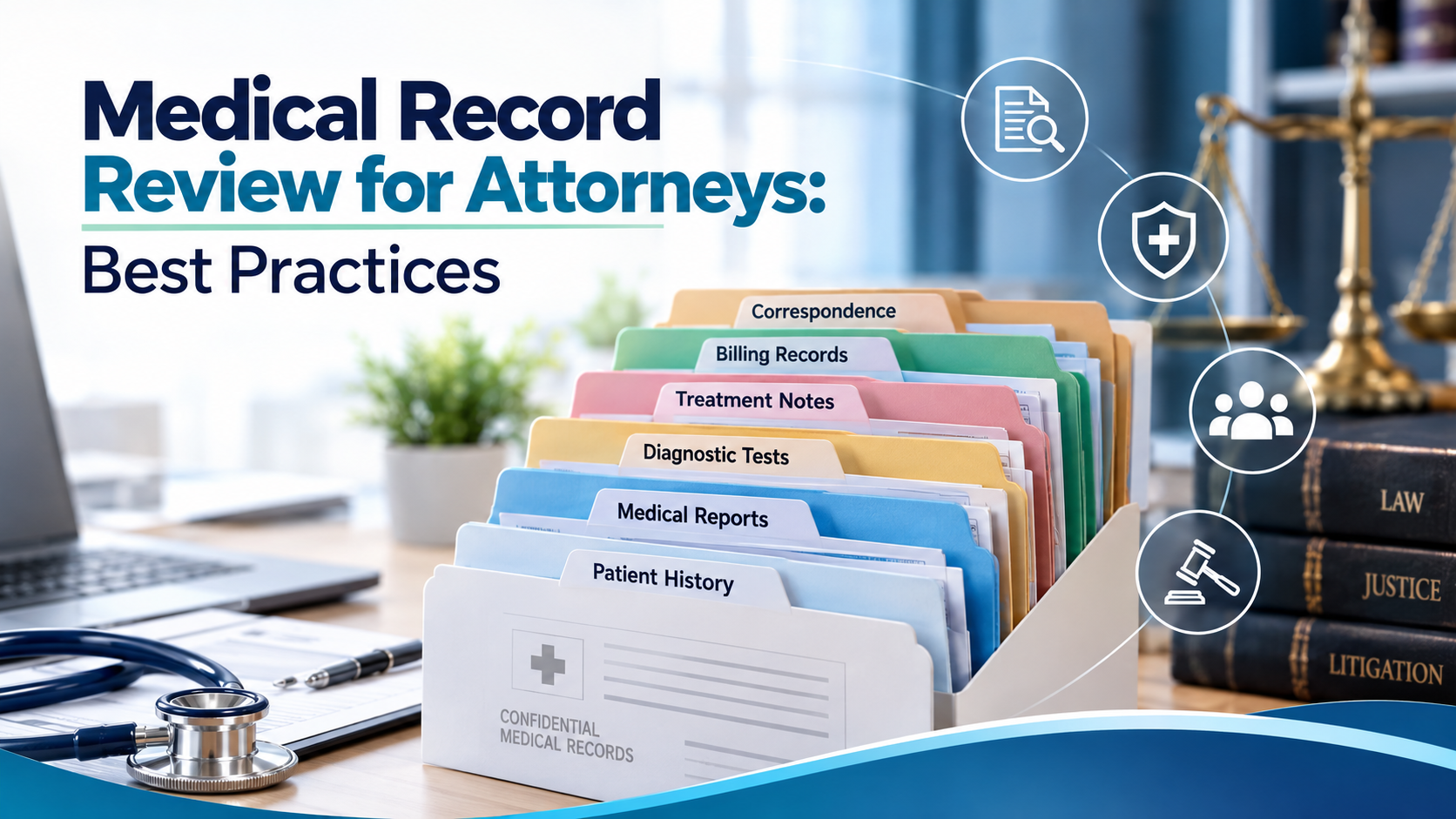
Medical Record Review for Attorneys: Best Practices
A practical guide to reviewing medical records accurately and efficiently — for personal injury, workers' compensation, medical malpractice, and disability claims.
Published: 2026-09-22
Medical records are often the single most important evidence category in personal injury, malpractice, and disability litigation — yet they arrive fragmented, duplicated, and hundreds of pages deep. A structured medical record review process is what separates a strong case narrative from a missed deadline or an overlooked causation gap.
Table of Contents
- Why Medical Record Review Matters in Legal Cases
- Common Challenges Attorneys Face
- Best Practices for Medical Record Review
- Record Types to Prioritize
- Tools and Techniques for Efficient Review
- Signs In-House Review Isn't Enough
- Why Firms Outsource Medical Record Review
- Choosing a Review Partner
- Frequently Asked Questions
1. Why Medical Record Review Matters in Legal Cases
In personal injury, workers' compensation, medical malpractice, and disability claims, medical records are the evidentiary backbone of the case. They establish the injury, document treatment, support or undermine causation, and quantify damages. A missed prior condition, an unlabeled radiology finding, or an overlooked gap in treatment can change the outcome of a settlement negotiation or trial.
For attorneys, the goal of medical record review is not simply to read the file — it is to convert hundreds or thousands of pages of clinical documentation into a defensible, chronological, and legally usable narrative that supports the theory of the case.
2. Common Challenges Attorneys Face When Reviewing Medical Records
- Records arriving from multiple providers, in inconsistent formats, and out of chronological order
- Duplicate pages, illegible handwriting, and scanned documents with poor OCR quality
- Time pressure from discovery deadlines and mediation dates
- Difficulty distinguishing pre-existing conditions from injury-related findings
- Billing records that don't align cleanly with the treatment record
- Associates and paralegals spending disproportionate hours on manual summarization instead of case strategy
3. Best Practices for Medical Record Review
Build a chronological timeline first
Before analysis begins, every record should be sorted into a single chronological timeline spanning pre-injury baseline, initial treatment, ongoing care, and current status. This timeline becomes the spine of the demand letter, deposition outline, or trial exhibit.
Organize by provider and record category
Within the timeline, group documentation by provider and by type — hospital, physician, diagnostic, pharmacy, and billing — so any reviewer can move between the narrative and the source document without re-reading the entire file.
Flag gaps, inconsistencies, and pre-existing conditions
Treatment gaps and conflicting diagnoses are exactly what opposing counsel will target. Flagging them proactively — with page references — lets the attorney address them head-on rather than being surprised in deposition.
Cross-reference billing against treatment records
Billing statements should be reconciled line-by-line against the clinical notes. Mismatches often reveal either missing records that still need to be requested, or billing errors that affect the damages calculation.
Isolate causation-relevant documentation
Any note that speaks to mechanism of injury, causation opinions, or apportionment should be extracted into its own reference list, since these excerpts are typically what gets cited in briefs and expert reports.
Use a standardized summary template
A consistent summary format — date, provider, findings, treatment, work status, and page citation — makes it possible to compare cases across a caseload and hand off files between team members without losing context.
Keep the record set indexed and searchable
A bookmarked, text-searchable PDF with a master index saves hours during deposition prep and trial, when a specific page often needs to be located in seconds.
4. Record Types Attorneys Should Prioritize
| Record Type | Why It Matters | What to Extract |
|---|---|---|
| Hospital & ER records | Establishes initial injury and diagnosis | Admission notes, discharge summary, imaging orders |
| Physician & specialist notes | Tracks treatment course and prognosis | Diagnoses, treatment plans, work restrictions |
| Diagnostic & imaging reports | Objective evidence of injury severity | Radiologist impressions, comparison to prior studies |
| Pharmacy & medication records | Corroborates pain, duration, and severity | Prescription history, dosage changes |
| Billing & insurance records | Supports damages calculation | Itemized charges, EOBs, liens |
5. Tools and Techniques for Efficient Review
- OCR and text-searchable PDF conversion for scanned or faxed records
- Bookmarked, hyperlinked PDF indexes tied to the chronology
- Standardized medical chronology templates shared across the litigation team
- Color-coded tagging for causation, damages, and credibility issues
- Dedicated medical record review specialists for high-volume or complex files
6. Signs In-House Review Isn't Enough
- Paralegals are spending more time summarizing records than on case strategy or client communication
- Discovery or mediation deadlines are being pushed due to review backlog
- Case volume has outgrown the firm's internal review capacity
- Summaries are inconsistent between team members, creating rework at deposition prep
- Files with thousands of pages need turnaround measured in days, not weeks
7. Why Firms Outsource Medical Record Review
Outsourcing medical record review to a dedicated team lets firms scale review capacity without adding headcount, standardizes chronology quality across every case, and frees paralegals and associates to focus on legal strategy rather than manual data entry. For firms handling personal injury, malpractice, or workers' compensation caseloads at volume, this shift often becomes the difference between a two-week and a two-day turnaround on a new intake.
8. Choosing the Right Medical Record Review Partner
Not every review vendor is built for legal work. Before engaging a partner, confirm they can meet these baseline standards:
Need Accurate Medical Record Review for Your Caseload?
Summit Global Services combines legal-trained reviewers with structured chronology templates to deliver fast, defensible medical record summaries for personal injury, malpractice, and workers' compensation cases.
Explore Medical Records Services9. Frequently Asked Questions
What is medical record review in a legal context?
It's the process of organizing, summarizing, and analyzing a claimant's medical records to build a chronological, litigation-ready narrative of injury, treatment, and damages.
Which case types rely most heavily on medical record review?
Personal injury, medical malpractice, workers' compensation, and Social Security disability cases all depend heavily on accurate, well-organized medical record chronologies.
How long does a medical record review typically take?
Turnaround depends on volume and complexity, but a professionally staffed review team can typically process a 500–1,000 page file within a few business days.
Is outsourced medical record review HIPAA-compliant?
A qualified vendor will operate under HIPAA-compliant data handling, secure file transfer protocols, and signed business associate agreements where applicable.
Can medical record review services help identify causation issues?
Yes — experienced reviewers flag treatment gaps, pre-existing conditions, and conflicting diagnoses that are directly relevant to causation and credibility arguments.