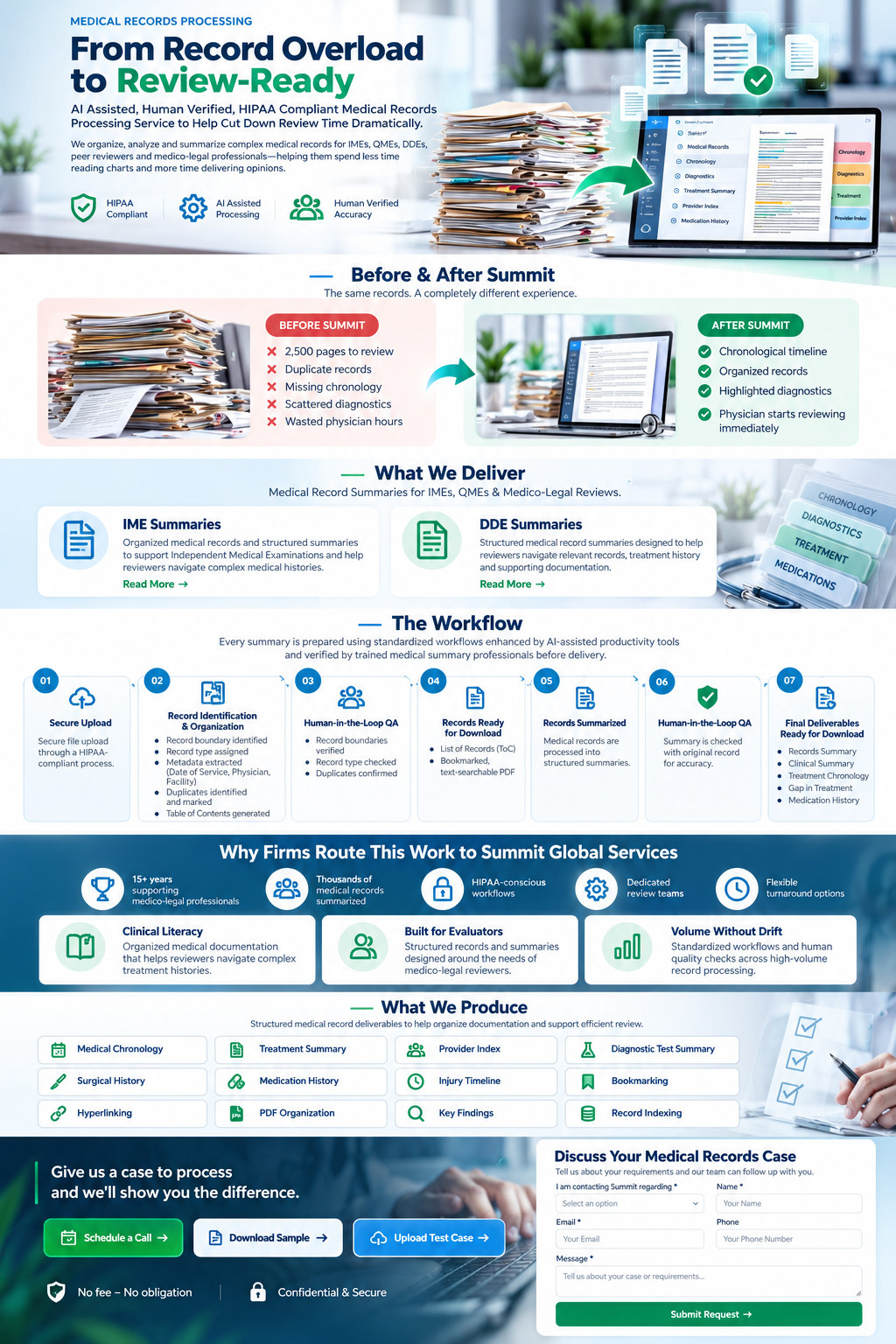
Helping Independent Medical Examiners efficiently review complex medical records, pinpoint critical clinical milestones, and prepare with confidence for one-time evaluations.
IME Review Support Services help Independent Medical Examiners efficiently review complex medical records and prepare for an evaluation. Support includes medical record organization, treatment chronology, diagnostic findings, prior medical history, treatment and therapy summaries, work-status history, identification of key medical events, and structured information needed to address the referring party’s questions.
Summit’s IME Physician Support Services help the examining physician prepare for a one-time evaluation.
Structured synthesis designed around the five fundamental questions the examiner must evaluate:
Clear mechanism of injury, emergency admission notes, initial reporting, and contemporaneous statements.
Sequential catalog of conservative care, surgeries, physical therapy, pain injections, and medications.
Objective recovery trajectories, response to interventions, functional milestones, or therapeutic plateaus.
Gaps in clinical logic, symptom magnification, unverified claims, or subjective complaints exceeding imaging.
Targeted anatomical checklist highlighting key examination focus areas and specific maneuvers to correlate.
Immediate high-level overview delivered on page one of every IME review file.
Chronological milestones tracing the claimant’s complete medical progression.
Date of Injury & contemporaneous incident reporting.
Emergency room presentation, triage, and immediate diagnostics.
Initial and follow-up imaging and radiological interpretations.
Operative reports, surgical technique, and post-op notes.
Physical therapy cycles, attendance compliance, and functional progress.
Injections, epidural steroids, nerve blocks, and pharmacological care.
Most recent physician examination and active complaint profile.
A thorough, date-ordered index of every physician encounter, clinic visit, hospital stay, therapy note, and consult report.
Systematic tracking showing whether therapeutic interventions produced demonstrable clinical recovery or if plateau occurred.
Consolidated catalog of all diagnostic modalities, radiology impressions, electrodiagnostic reports, and lab findings.
Critical clinical, chronological, and behavioral contradictions flagged for examiner scrutiny.
Every file undergoes rigorous analysis to identify discrepancies, gaps, and confounding factors across 10 vital parameters:
Day-to-day capability, work readiness, and physical assistive dependencies.
Activities of Daily Living: self-care, mobility, personal hygiene, driving capacity, and household maintenance ability.
Active employment standing, off-work notices, modified duty assignments, and historical work capacity documentation.
Specific physician-ordered limitations on lifting, carrying, bending, prolonged standing, walking, and postural demands.
Prescribed or self-utilized braces, splints, canes, walkers, crutches, orthotics, or assistive ergonomic equipment.